
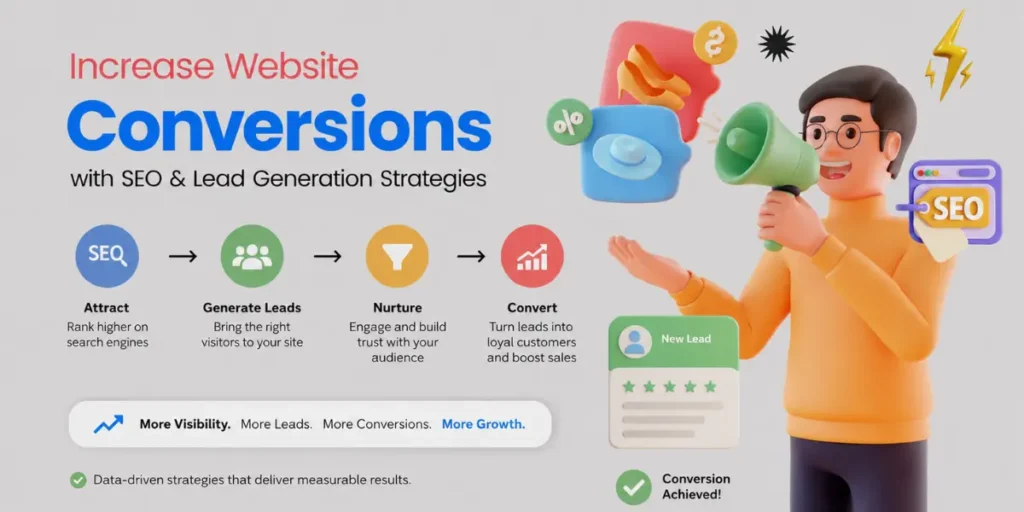
In today’s highly competitive digital landscape, generating website traffic alone is no longer enough. Businesses need visitors who are genuinely interested in their products or services and are likely to become paying customers. This is where SEO and lead generation strategies work together. While Search Engine Optimization (SEO) helps attract targeted visitors to your website, lead generation strategies help convert those visitors into valuable leads and customers.
Many businesses invest heavily in marketing campaigns but struggle to achieve meaningful conversions because they focus solely on driving traffic rather than optimizing the customer journey. A successful digital marketing strategy combines SEO, user experience, content marketing, and lead nurturing techniques to maximize conversions and business growth.
This guide explores the most effective SEO and lead generation strategies that can help increase website conversions, improve lead quality, and deliver sustainable business results.
What is the Relationship Between SEO and Lead Generation?
SEO and lead generation are closely connected. SEO helps businesses attract potential customers through search engines by improving website visibility for relevant keywords. Lead generation focuses on capturing visitor information and guiding prospects through the sales funnel.
When these two strategies work together, businesses can:
- Increase organic website traffic
- Attract highly targeted audiences
- Generate qualified leads
- Improve conversion rates
- Reduce customer acquisition costs
- Build long-term brand authority
Instead of chasing large amounts of traffic, businesses should focus on attracting users who have a genuine interest in their products or services. This approach leads to higher-quality leads and better conversion outcomes.
How to Conduct Keyword Research for Lead Generation?
Effective lead generation begins with understanding what your target audience is searching for online. Keyword research helps identify search terms that indicate strong user intent and purchasing interest.
Rather than targeting only high-volume keywords, businesses should focus on a mix of informational, commercial, and transactional keywords.
Examples include:
- Lead generation strategies
- Best lead generation tools
- SEO services for small businesses
- Digital marketing agency near me
- How to increase website conversions
Long-tail keywords are particularly valuable because they often attract visitors who are further along in the buying journey and more likely to convert.
Keyword research tools such as Google Keyword Planner, Ahrefs, SEMrush, and Ubersuggest can help identify valuable opportunities and understand search behavior.
Create High-Quality Content That Solves Problems
Content remains one of the most powerful tools for both SEO and lead generation. Search engines prioritize websites that provide useful, relevant, and authoritative information.
Businesses should create content that addresses customer pain points, answers common questions, and provides actionable solutions.
Some effective content formats include:
- Blog posts
- Guides and tutorials
- Case studies
- Whitepapers
- Checklists
- Video content
- FAQs

When visitors find valuable information on your website, they are more likely to trust your brand and engage with your offerings.
For example, a company offering SEO services can publish educational content about keyword research, technical SEO, and website optimization while naturally introducing its services as solutions.
How to Optimize Landing Pages for Higher Conversions?
Driving traffic to a website is only the first step. Landing pages play a crucial role in converting visitors into leads.
A high-converting landing page should include:
Clear and Compelling Headlines
Your headline should immediately communicate value and explain how your product or service solves a specific problem.
Strong Call-to-Action (CTA)
Every landing page should have a clear CTA that encourages visitors to take action.
Examples include:
- Request a Free Consultation
- Download the Guide
- Get a Free Audit
- Start Your Free Trial
- Contact Our Team
Simple Lead Capture Forms
Forms should request only essential information. Long and complicated forms often discourage users from converting.
Trust Signals
Include elements such as:
- Customer testimonials
- Client logos
- Certifications
- Reviews
- Case studies
Trust signals help reduce uncertainty and encourage conversions.
Improve Website Speed and Performance
Website speed significantly affects both SEO rankings and conversion rates.
Research consistently shows that users expect websites to load quickly. Slow-loading pages often result in higher bounce rates and lost conversion opportunities.
To improve website performance:
- Compress images
- Use modern image formats
- Enable browser caching
- Minify CSS and JavaScript
- Utilize Content Delivery Networks (CDNs)
- Reduce unnecessary plugins
Fast websites create better user experiences, improve search rankings, and increase conversion potential.
Focus on User Experience (UX)
A well-designed website encourages visitors to stay longer and engage with your content.
Key UX elements include:
Mobile Responsiveness
Most users now access websites through mobile devices. Responsive design ensures your site performs well across all screen sizes.
Easy Navigation
Visitors should be able to find information quickly and easily.
Readable Content Layout
Use:
- Short paragraphs
- Clear headings
- Bullet points
- Visual elements
These improvements make content easier to consume and improve engagement.
Consistent Design
A professional and consistent design builds credibility and trust among potential customers.
Use Lead Magnets to Capture Prospects
Lead magnets are valuable resources offered in exchange for visitor contact information.
Popular lead magnets include:
- eBooks
- Industry reports
- Templates
- Checklists
- Webinars
- Free trials
- Free consultations
- Resource guides
An effective lead magnet should provide immediate value and solve a specific problem for the target audience.
For example, a digital marketing agency might offer a free SEO audit or website performance checklist to attract qualified prospects.

Implement Content Upgrades
Content upgrades are targeted lead generation tools placed within blog posts and other content.
Examples include:
- Downloadable checklists
- PDF versions of articles
- Templates
- Worksheets
- Bonus resources
Since content upgrades are directly related to the article topic, they often achieve higher conversion rates than generic offers.
A blog about lead generation strategies might include a downloadable lead generation planning template that visitors can access after submitting their email address.
Leverage Local SEO for Lead Generation
Businesses serving specific geographic areas should prioritize local SEO strategies.
Local SEO helps attract nearby customers who are actively searching for products or services.
Important local SEO tactics include:
- Optimizing Google Business Profile
- Building local citations
- Encouraging customer reviews
- Creating location-specific content
- Using local keywords
When users search for services in their area, local SEO helps businesses appear in relevant search results and generate qualified leads.
Build Authority Through Link Building
Backlinks remain one of the most important ranking factors in SEO.
High-quality backlinks signal credibility and authority to search engines.
Effective link-building strategies include:
Guest Posting
Contribute valuable content to reputable industry websites.
Digital PR
Earn mentions from news sites, industry publications, and influencers.
Resource Link Building
Create valuable resources that others naturally reference and link to.
Industry Partnerships
Collaborate with relevant organizations and businesses to gain exposure and authority.
Strong backlink profiles improve search visibility and attract more targeted traffic
What is Conversion Rate Optimization (CRO) and How Does It Work?
Conversion Rate Optimization (CRO) focuses on increasing the percentage of website visitors who complete desired actions, such as filling out a contact form, downloading a resource, subscribing to a newsletter, or making a purchase. Rather than solely focusing on attracting more traffic, CRO aims to maximize the value of existing visitors by improving their experience and encouraging conversions. Effective CRO strategies include A/B testing headlines and call-to-action (CTA) buttons, optimizing page layouts, simplifying lead capture forms, enhancing mobile usability, and eliminating unnecessary distractions that may prevent users from taking action. Even minor improvements in these areas can lead to significant increases in lead generation and sales without requiring additional website traffic. Businesses that continuously analyze user behavior, test different elements, and optimize their websites over time often achieve higher conversion rates and better overall marketing performance.
Utilize Email Marketing for Lead Nurturing
Not every website visitor is ready to make a purchase immediately, which is why email marketing plays a crucial role in lead nurturing. Through well-planned email campaigns, businesses can educate prospects, build trust, share valuable content, promote relevant offers, and maintain ongoing engagement with potential customers. A structured email sequence helps guide leads through different stages of the buyer’s journey, keeping the brand top-of-mind until they are ready to take action. Additionally, personalized email communication can significantly improve engagement rates, strengthen customer relationships, and generate higher-quality leads, ultimately increasing conversion opportunities and driving business growth.
Create SEO-Focused Blog Content Consistently
Consistent blogging remains one of the most effective ways to generate organic traffic and leads.
Regular blog publishing helps businesses:
- Rank for more keywords
- Demonstrate expertise
- Attract targeted audiences
- Generate backlinks
- Increase brand visibility
Focus on creating content that aligns with customer needs and search intent.
Examples include:
- Industry trends
- How-to guides
- Case studies
- Product comparisons
- Best practices
- Expert insights
The more useful content your website provides, the more opportunities you create for lead generation.
Use Social Proof to Increase Trust
Trust plays a major role in conversion decisions.
Potential customers are more likely to engage with businesses that demonstrate credibility through social proof.
Examples of social proof include:
- Customer reviews
- Testimonials
- Case studies
- Success stories
- Industry awards
- Client portfolios
Displaying positive experiences from existing customers helps reassure potential leads and reduces purchasing hesitation.
Track and Measure Performance
Successful SEO and lead generation strategies depend on continuous monitoring, analysis, and optimization. Businesses should regularly track key performance metrics such as organic traffic, conversion rates, bounce rates, time on page, lead quality, cost per lead, form submissions, and landing page performance to understand how effectively their marketing efforts are performing. Tools like Google Analytics, Google Search Console, and marketing automation platforms provide valuable insights into user behavior and campaign performance. By consistently reviewing this data, businesses can identify strengths, uncover areas for improvement, make data-driven decisions, and refine their SEO and lead generation strategies to achieve higher conversions and better long-term results.
Common Mistakes to Avoid
Many businesses struggle with lead generation because they make avoidable mistakes.
Common issues include:
- Targeting irrelevant keywords
- Ignoring search intent
- Using weak CTAs
- Creating poor landing pages
- Neglecting mobile optimization
- Publishing low-quality content
- Failing to track conversions
- Using complicated forms
Avoiding these mistakes can significantly improve lead generation performance and conversion outcomes
Conclusion
SEO and lead generation strategies are most effective when they work together as part of a unified digital marketing approach. SEO brings qualified visitors to your website, while lead generation techniques convert those visitors into valuable business opportunities.
By conducting strategic keyword research, creating high-quality content, optimizing landing pages, improving website performance, leveraging local SEO, building authority through backlinks, and continuously optimizing conversion rates, businesses can generate more qualified leads and increase website conversions.
Long-term success requires consistency, ongoing optimization, and a deep understanding of customer needs. Businesses that invest in both SEO and lead generation will be better positioned to attract targeted audiences, build lasting relationships, and achieve sustainable growth in an increasingly competitive digital environment.