
In today’s competitive market, businesses are constantly searching for ways to improve efficiency, reduce costs, and increase productivity. As a result, many organizations are turning to business automation tools to streamline their daily operations. These tools help automate repetitive tasks, allowing employees to focus on strategic activities that contribute to business growth.
Whether you run a small startup or a large enterprise, implementing the right business automation tools can transform the way your organization operates. From marketing and customer service to accounting and project management, automation solutions can save valuable time while improving accuracy and consistency.
In this guide, you will learn what business automation tools are, why they matter, their key benefits, and how to choose the best solutions for your business needs.
What Are Business Automation Tools?
Business automation tools are software applications designed to automate routine tasks and workflows that would otherwise require manual effort. Instead of spending hours on repetitive activities, businesses can use automation technology to complete these tasks quickly and accurately.
For example, automation tools can schedule emails, generate reports, manage customer relationships, process invoices, and track project progress. Consequently, teams can focus on innovation, customer engagement, and business development.
Furthermore, modern automation platforms often integrate with other software systems, creating seamless workflows across departments.
Why Business Automation Tools Are Important
As businesses grow, managing operations manually becomes increasingly difficult. Therefore, organizations need efficient systems that can handle complex processes without sacrificing quality.
The importance of business tools includes:
- Reducing human error
- Saving time on repetitive tasks
- Increasing employee productivity
- Improving customer experiences
- Enhancing operational efficiency
- Supporting business scalability
Moreover, automation enables businesses to respond more quickly to customer needs and market changes.
Key Benefits of Business Automation Tools
Increased Productivity
One of the biggest advantages of business automation tools is increased productivity. Employees no longer need to spend hours completing repetitive administrative tasks.
Instead, automated systems can perform these functions automatically, allowing teams to focus on high-value activities.
Improved Accuracy
Manual processes often lead to mistakes. However, automation significantly reduces the risk of human error.
As a result, businesses can maintain more accurate records, improve reporting, and ensure consistency across operations.
Better Customer Service
Customer satisfaction is critical for long-term success. Fortunately, automation tools can improve response times and enhance customer interactions.
For instance, automated chatbots can answer common questions instantly, while customer relationship management systems can track interactions and preferences.
Cost Savings
Although automation requires an initial investment, it often reduces operational costs over time.
Businesses can accomplish more with fewer resources, which ultimately improves profitability.
Enhanced Decision-Making
Automation platforms frequently provide detailed analytics and reporting capabilities.
Therefore, business leaders can access real-time data and make informed decisions based on accurate information.
Types of Business Automation Tools
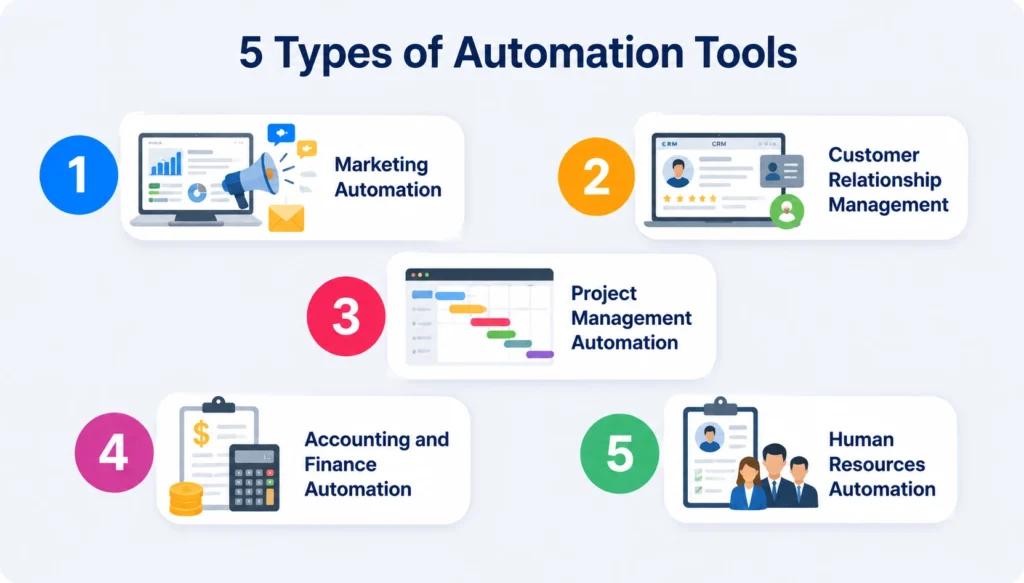
Different organizations have different needs. Consequently, there are several categories of automation tools available.
Marketing Automation Tools
Marketing automation platforms help businesses manage campaigns more efficiently.
Common functions include:
- Email marketing automation
- Lead nurturing
- Social media scheduling
- Customer segmentation
- Campaign tracking
These tools ensure consistent communication while reducing manual effort.
Customer Relationship Management Tools
Customer relationship management systems help businesses organize and manage customer interactions.
Key features often include:
- Contact management
- Sales pipeline tracking
- Customer support integration
- Lead management
- Reporting dashboards
As a result, businesses can build stronger relationships with customers.
Project Management Automation Tools
Project management software improves team collaboration and workflow organization.
Typical capabilities include:
- Task assignment
- Deadline tracking
- Workflow
- Team communication
- Resource management
Consequently, projects can be completed more efficiently and on schedule.
Accounting and Finance Automation Tools
Financial management involves many repetitive tasks. Therefore, automation can significantly improve efficiency.
Examples include:
- Invoice generation
- Expense tracking
- Payroll processing
- Financial reporting
- Tax calculations
These tools help businesses maintain accurate financial records while saving time.
Human Resources Automation Tools
Human resources departments can also benefit from automation.
Common HR automation functions include:
- Employee onboarding
- Attendance tracking
- Leave management
- Performance evaluations
- Recruitment workflows
Furthermore, automation allows HR teams to focus more on employee development and engagement.
How Business Automation Tools Improve Workflow Efficiency
Efficient workflows are essential for business success. Fortunately, business automation tools help eliminate bottlenecks and streamline operations.
Consider the following example:
| Manual Process | Automated Process |
|---|---|
| Data entry performed manually | Data entered automatically |
| Reports created individually | Reports generated instantly |
| Customer follow-ups handled manually | Automated email sequences |
| Task assignments managed manually | Workflow-based task assignment |
| Invoices prepared individually | Automatic invoice generation |
As shown above, automation reduces delays and improves consistency throughout business operations.
Choosing the Right Business Automation Tools
Selecting the right solution requires careful planning.
Identify Business Needs
Before investing in automation software, identify the challenges your organization wants to solve.
Ask questions such as:
- Which tasks consume the most time?
- Where do errors frequently occur?
- Which processes need improvement?
By understanding your needs, you can select tools that deliver the greatest value.
Consider Integration Capabilities
Businesses often use multiple software systems. Therefore, it is important to choose business tools that integrate easily with existing platforms.
Effective integration reduces data silos and improves workflow efficiency.
Evaluate Scalability
As your organization grows, your automation requirements may change.
For this reason, select solutions that can scale alongside your business.
Review User Experience
Complicated software can slow adoption and reduce effectiveness.
Instead, choose tools with intuitive interfaces and clear documentation.
Analyze Costs and ROI
While pricing is important, businesses should also evaluate potential returns.
In many cases, the productivity gains achieved through automation justify the investment.
Common Challenges When Implementing Business Automation Tools


Although automation offers significant benefits, implementation may present challenges.
Employee Resistance
Some employees may worry that automation will replace their jobs.
However, businesses should emphasize that automation is designed to support employees rather than eliminate positions.
Poor Planning
Without proper planning, automation projects can fail to achieve desired outcomes.
Therefore, organizations should establish clear goals and implementation strategies.
Inadequate Training
Employees need proper training to maximize the benefits of automation tools.
As a result, businesses should invest in education and support programs.
Over-Automation
Not every process should be automated.
In some situations, human judgment remains essential for maintaining quality and customer satisfaction.
Best Practices for Using Business Automation Tools
To maximize success, businesses should follow proven automation practices.
Start Small
Rather than automating everything at once, begin with a few high-impact processes.
This approach allows teams to learn and adapt gradually.
Monitor Performance
Automation should be continuously evaluated.
Track key metrics such as productivity, accuracy, customer satisfaction, and cost savings.
Update Workflows Regularly
Business processes evolve over time. Therefore, automation workflows should be reviewed and updated regularly.
Maintain Human Oversight
Although automation improves efficiency, human oversight remains important.
Employees should monitor automated processes and address exceptions when necessary.
The Future of Business Automation Tools
Technology continues to evolve rapidly. Consequently, the future of automation tools looks increasingly promising.
Artificial intelligence and machine learning are enhancing automation capabilities by enabling systems to learn from data and make intelligent decisions.
Future developments may include:
- Advanced predictive analytics
- AI-powered customer support
- Intelligent workflow optimization
- Enhanced personalization
- Improved business forecasting
As these technologies mature, businesses will gain even greater opportunities to improve efficiency and competitiveness.
Frequently Asked Questions
Business automation tools are software solutions that automate repetitive tasks and workflows to improve efficiency, accuracy, and productivity.
Business automation tools help organizations save time, reduce errors, improve customer service, and support scalable growth.
Marketing, sales, customer service, human resources, finance, and project management departments can all benefit from automation.
Yes. Many business automation tools are designed specifically for small businesses and offer affordable pricing options.
They eliminate repetitive manual tasks, allowing employees to focus on strategic activities that generate greater business value.
Organizations should evaluate their needs, integration capabilities, scalability, user experience, and potential return on investment before selecting a solution.
Conclusion
Business automation tools have become essential for organizations seeking greater efficiency, productivity, and growth. By automating repetitive tasks, businesses can reduce costs, improve accuracy, and enhance customer experiences.
Whether you are automating marketing, customer service, finance, or project management, the right tools can transform operations and support long-term success. Furthermore, as automation technology continues to advance, businesses that embrace these solutions will be better positioned to compete in an increasingly digital marketplace.
Investing in business automation tools is not simply about saving time. Instead, it is about creating smarter processes, empowering employees, and building a stronger foundation for future growth.