
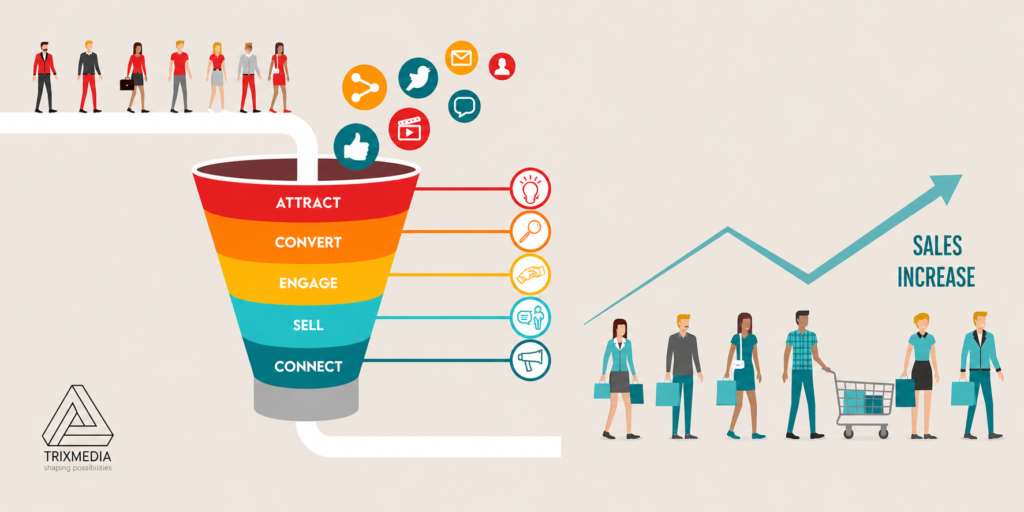
Sales Funnels for Beginners is an essential concept for businesses looking to turn website visitors into paying customers. In today’s competitive digital landscape, attracting visitors is only the first step toward business success. The real challenge lies in converting those visitors into customers. This is where a sales funnel becomes valuable. A sales funnel is a structured process that guides potential customers through different stages of their buying journey, from discovering your business to making a purchase and becoming loyal customers.
For beginners, understanding how a sales funnel works can seem complicated. However, once you learn the basic stages and strategies, you can create a system that consistently generates leads and increases conversions. Moreover, whether you run a small business, an eCommerce store, or a service-based company, an effective sales funnel can help you attract the right audience and grow your revenue.
This guide explains the fundamentals of a sales funnel for beginners, its key stages, and practical steps to build one that converts leads into customers.
What Is a Sales Funnel?
A sales funnel is a marketing and sales framework that represents the customer journey from the first interaction with your brand to the final purchase . It is called a funnel because many people may enter at the top and, as a result, only a smaller number eventually become customers .In essence, the purpose of a sales funnel is to guide potential buyers through a series of steps that build awareness, trust, and interest until they are ready to make a purchase decision.
Without a sales funnel, businesses often struggle to nurture leads effectively, resulting in lost opportunities and lower conversion rates.
Why Is a Sales Funnel Important?
A sales funnel helps businesses understand customer behavior and optimize each stage of the buying process. Instead of relying on random marketing efforts, companies can create a structured system that moves prospects toward conversion.
Key benefits of a sales funnel include:
- Better lead generation
- Higher conversion rates
- Improved customer relationships
- More predictable sales growth
- Increased return on marketing investment
- Better understanding of customer needs
When implemented correctly, a sales funnel can turn casual website visitors into long-term customers.
Understanding the Stages of a Sales Funnel
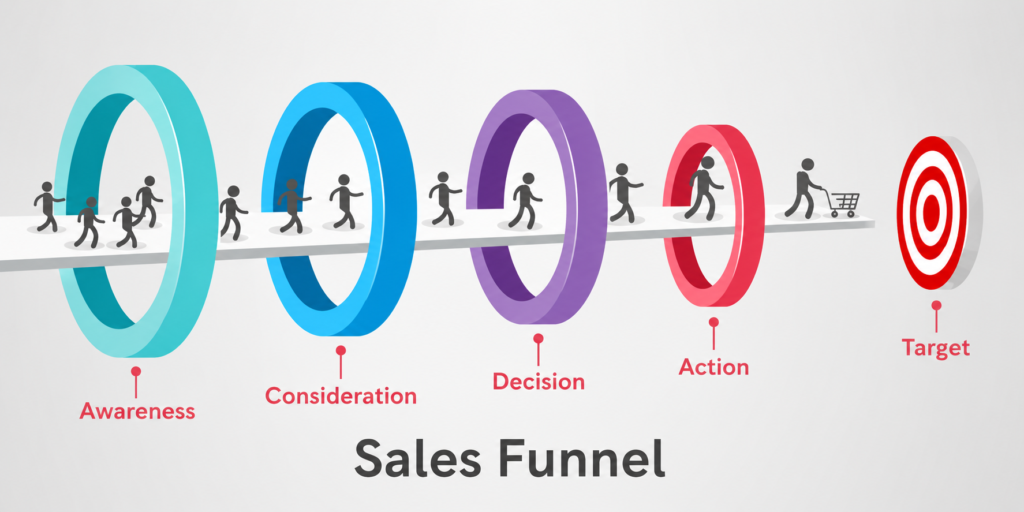
Most sales funnels consist of four primary stages: Awareness, Interest, Decision, and Action. Each stage represents a different phase of the customer journey.
1. Awareness Stage
The awareness stage is the top of the funnel, where potential customers first discover your business. At this point, they may not know much about your products or services and, therefore, are often searching for information or solutions to a problem.
Common ways to attract people during this stage include:
- Search Engine Optimization (SEO)
- Blog content
- Social media marketing
- Online advertisements
- Video marketing
- Guest posting
In fact, the goal is not to sell immediately but to introduce your brand and capture attention.
For example, if someone searches for “how to improve website speed,” they may find your blog article and, as a result, learn about your web development services.
2. Interest Stage
Once people become aware of your brand, they move into the interest stage. Here, they start exploring your business and learning more about your offerings.
Your objective is to provide valuable information and build trust.
Effective strategies for this stage include:
- Educational blog posts
- Email newsletters
- Free guides and eBooks
- Webinars
- Case studies
- Informative videos
At this stage, visitors are evaluating whether your business can solve their problems. Therefore, providing helpful content positions you as a trusted authority in your industry.
3. Decision Stage
In the decision stage, potential customers are actively considering their options. They understand their problem and are comparing different solutions before making a purchase decision.
This is the time to highlight why your product or service is the best choice.
Effective tactics include:
- Product demonstrations
- Customer testimonials
- Free trials
- Detailed case studies
- Pricing information
- Comparison guides
Trust plays a major role here. Showing proof of success through reviews and testimonials can significantly increase conversion rates.
4. Action Stage
The action stage is the bottom of the funnel, where prospects become customers.
At this point, your goal is to make the purchasing process as easy as possible.
Ways to encourage action include:
- Clear Call-to-Action (CTA) buttons
- Simple checkout processes
- Easy contact forms
- Limited-time offers
- Discounts and promotions
- Personalized recommendations
A complicated checkout process or confusing navigation can cause users to abandon their purchase, so simplicity is essential.
How to Build Sales Funnels for Beginners
Creating sales funnels for beginners does not require advanced technical skills. By following a few simple steps, beginners can build a funnel that attracts potential customers and increases conversions.
Define Your Target Audience for Sales Funnels for Beginners
Before creating sales funnels for beginners, you must understand who your ideal customers are. The more you know about your audience, the easier it becomes to guide them through the buying journey.
Identify:
- Demographics
- Interests
- Pain points
- Goals
- Online behavior
As a result, you can create more relevant marketing messages and improve conversion rates.
Create Valuable Content for Sales Funnels for Beginners
Content is one of the most important components of sales funnels for beginners. It helps attract visitors, build trust, and encourage prospects to take action.
Top of Funnel Content in Sales Funnels for Beginners
At this stage, your goal is to attract potential customers and introduce them to your brand.
Examples include:
- Blog posts
- Social media content
- Educational videos
Middle of Funnel Content in Sales Funnels for Beginners
Once prospects show interest, you should provide content that helps them evaluate their options.
Examples include:
- Email campaigns
- Guides and eBooks
- Webinars
Bottom of Funnel Content in Sales Funnels for Beginners
At the final stage, your content should encourage prospects to become customers.
Examples include:
- Product demos
- Testimonials
- Case studies
Therefore, creating quality content for every stage of sales funnels for beginners is important. In addition, it helps attract, educate, and persuade potential customers more effectively.
Capture Leads
Once visitors arrive on your website, you need a way to collect their information.
Popular lead generation methods include:
- Contact forms
- Newsletter sign-ups
- Free downloadable resources
- Free consultations
- Webinar registrations
Offering something valuable in exchange for contact information encourages visitors to enter your funnel
Nurture Leads Through Email Marketing
Not every lead is ready to buy immediately. Email marketing allows you to build relationships over time.
Effective email sequences can:
- Educate prospects
- Share success stories
- Answer common questions
- Promote special offers
Consistent communication keeps your brand top-of-mind until prospects are ready to purchase.
Optimize Conversion Opportunities
Every stage of your funnel should encourage users to move to the next step.
Examples include:
- Strong CTA buttons
- Clear landing pages
- Simplified forms
- Mobile-friendly design
- Fast-loading pages
Small improvements can have a significant impact on overall conversion rates.
Common Sales Funnel Mistakes to Avoid
Many beginners make mistakes that reduce the effectiveness of their sales funnels.
Some common errors include:
Focusing Only on Sales
Trying to sell immediately often drives prospects away. Building trust first leads to better long-term results.
Ignoring Lead Nurturing
Not all leads convert instantly. Regular communication helps maintain engagement and encourages future purchases.
Complicated User Experience
Confusing navigation, long forms, and slow-loading pages create friction and reduce conversions.
Lack of Analytics
Without tracking performance, it is difficult to identify areas for improvement.
Weak Call-to-Actions
Visitors need clear instructions about what action to take next.
Measuring Sales Funnel Performance
To improve your sales funnel, monitor important performance metrics such as:
- Website traffic
- Lead generation rate
- Email open rates
- Click-through rates
- Conversion rate
- Customer acquisition cost
- Return on investment (ROI)
Regular analysis helps identify bottlenecks and opportunities for optimization.
The Role of Automation in Sales Funnels
As your business grows, automation can make your sales funnel more efficient.
Marketing automation tools can:
- Send automated emails
- Track customer behavior
- Score leads
- Schedule follow-ups
- Personalize communications
Automation saves time while ensuring that leads receive consistent and relevant information.
Frequently Asked Questions (FAQs)
A sales funnel guides potential customers from discovering your business to making a purchase. Moreover, it helps attract leads, build trust, and convert prospects into customers.
The main stages of a sales funnel are Awareness, Interest, Decision, and Action. These stages help move potential customers from learning about your brand to evaluating your solution and ultimately making a purchase.
Sales funnels for beginners help businesses organize marketing efforts, nurture leads, increase conversions, and create a more predictable sales process. Additionally, they help identify where potential customers drop out of the buying journey.
Beginners can create a sales funnel by identifying their target audience, creating valuable content, capturing leads through forms or offers, nurturing leads with email marketing, and optimizing conversion opportunities with clear calls-to-action.
Businesses often use CRM software, email marketing platforms, analytics tools, and marketing automation software to manage and optimize their sales funnels. These tools help track leads, automate communication, and measure performance.
Moreover, sales funnel success can be measured using metrics such as website traffic, lead generation rate, conversion rate, click-through rate, customer acquisition cost, and return on investment (ROI). As a result, regular monitoring helps improve funnel performance.
A lead is a potential customer who has shown interest in your business, while a customer is someone who has completed a purchase. Therefore, the goal of a sales funnel is to guide leads through the buying process until they become customers.
Conclusion
A sales funnel is one of the most effective tools for turning website visitors into paying customers. By guiding prospects through the stages of awareness, interest, decision, and action, businesses can create a structured path that increases conversions and supports long-term growth.
For beginners, the key is to focus on understanding the audience, creating valuable content, capturing leads, nurturing relationships, and optimizing every stage of the customer journey. While building an effective sales funnel takes time and testing, the results can significantly improve lead generation, customer acquisition, and overall business success.